
An orchestra may look like a large group of musicians simply arranged in rows, but there is a great deal of thought behind where each player sits. From the first violinist at the front to the percussion section at the back, an orchestra’s seating plan is designed to balance sound, communication, musical blend, visibility, and practicality.
Although many orchestras follow familiar traditional layouts, there is no single arrangement that applies everywhere. Seating can change according to the conductor, concert hall, orchestra, musical period, composer, or specific piece being performed. A Beethoven symphony may call for a different arrangement from a Mahler symphony, while a modern work could require musicians to be spread around the stage.
Understanding orchestral seating reveals an important truth: an orchestra is not simply a collection of individual musicians. It is a carefully coordinated musical system in which where musicians sit can influence how they hear, play, communicate, and ultimately sound as an ensemble.
The Traditional Orchestra Seating Arrangement
The traditional symphony orchestra is usually organized into four main instrument families: strings, woodwinds, brass, and percussion. Within those sections, instruments are positioned according to their musical roles, range, volume, and relationship to other instruments.
A typical modern orchestral layout looks roughly like this:
| Section | Common position | Main reason for placement |
|---|---|---|
| First violins | Front left | Lead melodic material and strong communication with conductor |
| Second violins | Front right or beside first violins | Creates balance and dialogue with first violins |
| Violas | Center-left or center | Bridges upper and lower string registers |
| Cellos | Center-right | Provides lower melodic and harmonic support |
| Double basses | Behind or beside cellos | Powerful low-frequency foundation |
| Woodwinds | Center/rear | Need clear projection and interaction with strings |
| French horns | Rear-center/left | Blend with winds and support harmonic color |
| Trumpets and trombones | Rear | Strong projection requires distance from other players |
| Tuba | Rear | Very powerful low-frequency sound |
| Percussion | Back | Requires space and protects the balance of the ensemble |
This is only a general model. Individual orchestras can use noticeably different seating plans.
Why Are the Strings Usually at the Front?
Strings generally occupy the largest area of the orchestra. Violins, violas, cellos, and double basses also perform continuously through much of a symphonic work, making their placement particularly important.
First Violins
The first violins traditionally sit toward the conductor’s left. The concertmaster, or leader of the orchestra, occupies the prominent chair closest to the conductor.
This position is significant for several reasons. The concertmaster has an important leadership role and frequently communicates with the conductor and other musicians. They also help coordinate bowing, articulation, tuning, and ensemble decisions within the violin section.
First violins often carry prominent melodies, so placing them toward the front makes their musical role easy for the conductor to monitor.
Second Violins
Second violins have historically occupied the opposite side of the stage from the first violins. This arrangement creates an interesting form of musical conversation.
Composers frequently write passages in which first and second violins answer one another. Positioning the sections opposite each other can make these exchanges easier for the musicians to hear.
However, many orchestras place second violins beside the first violins instead. This arrangement can encourage a more unified string sound and may make sectional coordination easier.
Violas and Cellos
Violas commonly sit between the violins and cellos, although their exact position varies. Their sound occupies a middle register, making them a natural bridge between the higher and lower strings.
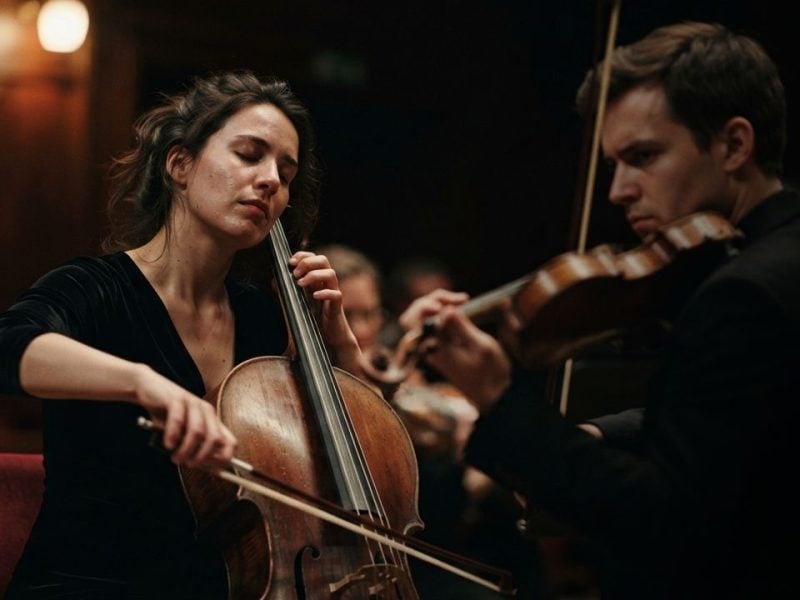
Cellos often sit toward the center or right side of the stage. Their rich, resonant sound contributes both melody and harmony, while their lower register helps connect the upper strings to the double basses.
Double Basses
Double basses are normally positioned toward the rear or side of the string section. Their enormous instruments produce powerful low frequencies, and placing them farther back can help distribute their sound throughout the hall.
Their physical size also affects seating. Double bass players need considerably more space than violinists, and their instruments are awkward to place in tightly packed rows.
Why Are the Woodwinds in the Middle?
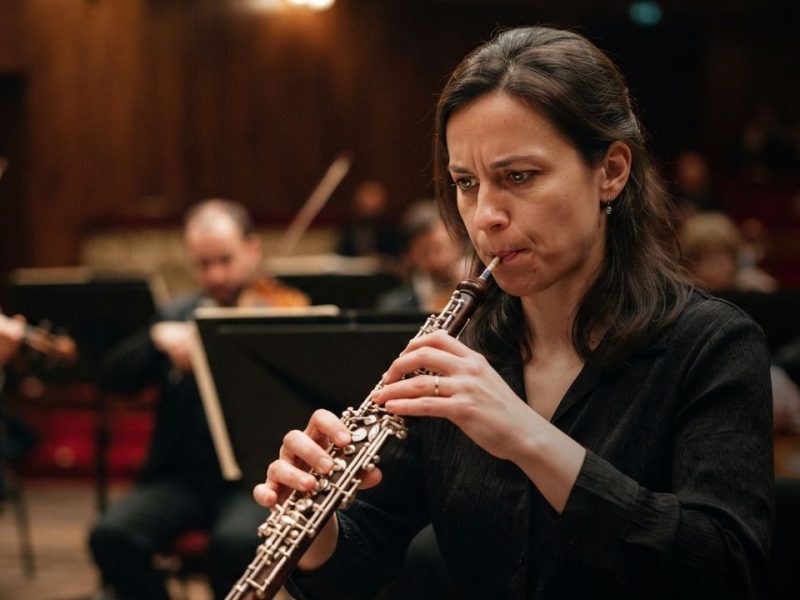
The woodwind section generally sits behind the strings, often in one or more rows containing flutes, oboes, clarinets, and bassoons.
This location allows woodwind players to maintain a strong relationship with both the conductor and the strings.
Flutes and Oboes
Flutes and oboes produce relatively penetrating sounds that can travel effectively across an orchestra. They therefore do not necessarily need to be placed at the front to be heard.
Oboes have an additional practical responsibility: the principal oboist traditionally provides the tuning note, usually an A, before the performance begins. This makes the oboe a highly visible and important member of the ensemble.
Clarinets and Bassoons
Clarinets have considerable flexibility in tone and range, while bassoons contribute lower woodwind colors. Their positions help them interact with both the other woodwinds and the strings.
The woodwind section is also arranged so that players can see the conductor clearly while maintaining enough acoustic separation to hear their colleagues.
Why Are Brass Instruments at the Back?
Brass instruments are generally placed behind the strings and woodwinds because they can produce substantially more sound.
Trumpets, trombones, French horns, and tubas can easily overpower quieter instruments if they are positioned too close to the audience or to delicate sections of the orchestra.
Acoustic Power Matters
One of the most important principles of orchestral seating is acoustic balance.
A violin and a trumpet do not produce comparable levels of sound. If a trumpet section sat at the front of the orchestra, its sound could dominate the entire ensemble.
Placing brass instruments farther back allows their sound to travel over the musicians in front of them before reaching the audience. The distance and stage architecture can help soften the impact and produce a more balanced orchestral sound.
French Horns Are a Special Case
French horns can be positioned differently from other brass instruments. Their sound is naturally more blended and can connect the brass, woodwind, and string sections.
The direction in which a horn’s bell points also affects its sound. Horn players historically played with their bells facing backward, and modern placement still reflects some of this instrument’s distinctive acoustic characteristics.
Why Is Percussion at the Back?
Percussion instruments are usually located at the rear because many of them are extremely loud and require substantial physical space.
Timpani, bass drums, cymbals, tam-tams, and other large instruments cannot simply be squeezed into the middle of the orchestra.
Space and Practicality
Percussionists may need to move between several instruments during a single piece. Their area therefore has to accommodate large instruments, mallets, stands, chairs, and movement.
The rear of the stage provides room without interfering with the string, woodwind, and brass players.
Sound Projection
Percussion instruments can project strongly across a concert hall. Keeping them farther from the audience helps prevent individual attacks from becoming excessively dominant.
However, percussion placement is not purely about reducing volume. The conductor and percussionists also need to consider how long it takes sound to travel from the back of the stage to other sections.
How Seating Helps Musicians Hear One Another
An orchestra is a highly collaborative environment. Musicians need to hear what is happening around them while also following the conductor.
This is one reason orchestral seating cannot be based on visual appearance alone.
Musical Communication
Musicians constantly listen for:
- Rhythmic coordination
- Intonation
- Changes in dynamics
- Articulation
- Tempo
- Balance
- Musical cues
- The beginning and ending of phrases
A player may be technically excellent but still struggle if they cannot hear the colleagues whose parts interact closely with theirs.
For example, a violinist playing a rhythmic figure alongside a woodwind instrument needs to hear both the conductor and the other player. Seating can make that communication easier or more difficult.
The Conductor Changes the Equation
The conductor is usually positioned at the front center because this provides the clearest visual connection with the entire ensemble.
Every musician needs to be able to see the conductor’s gestures, particularly when the music contains complicated entrances, tempo changes, or expressive cues.
But the conductor’s position also affects how musicians perceive the orchestra.
A conductor standing slightly higher than the musicians can see across the entire ensemble. At the same time, the musicians must be arranged so that sightlines remain reasonably clear.
Conductors May Prefer Different Layouts
Conductors sometimes have strong preferences about orchestral seating. Some prefer second violins opposite first violins because it emphasizes antiphonal musical exchanges. Others prefer the two violin sections together because it creates greater unity.
A conductor may also request a particular arrangement to emphasize the composer’s intentions.
This means that two orchestras performing exactly the same piece may look different on stage while producing equally convincing performances.
Acoustic Differences Between Concert Halls
The concert venue is another major factor in orchestral seating.
Every concert hall has different dimensions, surfaces, stage shapes, ceilings, balconies, and reverberation characteristics. These features influence how sound travels.
Reverberation and Clarity
A highly reverberant hall can make an orchestra sound warm and expansive, but too much reverberation may blur rapid musical passages.
A relatively dry hall may provide excellent clarity but make the ensemble sound less blended.
Orchestral musicians and conductors may adjust their approach accordingly. Seating can also be modified to help achieve the desired balance.
For instance, moving a powerful brass section slightly farther back or changing the arrangement of string sections can affect how sound reaches both the audience and the performers.
Seating Can Change With the Repertoire
One of the most interesting aspects of orchestral seating is that the music itself can determine the arrangement.
A classical-period orchestra is often smaller than the huge forces required by late-Romantic repertoire. A Mozart symphony may use a relatively compact ensemble, whereas a Mahler symphony can require enormous sections of strings, brass, woodwinds, percussion, and additional instruments.
Different Composers, Different Requirements
Composers sometimes deliberately exploit spatial relationships between instruments.
A piece may call for:
- Antiphonal strings
- Offstage brass
- Surrounding percussion
- Soloists positioned prominently
- Choirs behind the orchestra
- Groups of instruments separated across the stage
- Chamber-like ensembles within a larger orchestra
In these situations, the conventional seating plan becomes only a starting point.
Historical Orchestra Seating
Modern orchestral seating is also the result of centuries of musical tradition.
The orchestra has changed dramatically since the Baroque and Classical periods. Early orchestras were often smaller, and instrumental groups were organized differently.
During the nineteenth century, orchestras expanded significantly. New instruments were developed, existing instruments became more powerful, and composers demanded larger and more varied ensembles.
As orchestras grew, seating arrangements had to evolve to maintain balance.
This historical development explains why there is no universal “correct” seating plan. Traditional arrangements are conventions that have been refined over time rather than fixed rules.
Why Musicians Do Not Simply Sit Wherever They Want
An orchestra is not like a classroom where students can choose any available seat. Seating has consequences for both the individual musician and the ensemble.
Section Hierarchy
Within many orchestral sections, seating reflects musical responsibilities.
The principal player generally sits at the front and has additional leadership duties. Other players sit according to their roles, experience, and the orchestra’s internal system.
The seating order can influence who plays exposed passages, who leads a section, and who communicates directly with the principal.
Physical Practicalities
Musicians also need enough room to perform comfortably.
String players require space for their bows. Percussionists need access to multiple instruments. Harpists require substantial floor space. Tuba and double bass players need room for their large instruments.
Therefore, the orchestra’s seating plan is partly an exercise in stage logistics.
Why Orchestral Seating Is Not Always Symmetrical
A concert audience might expect an orchestra to be perfectly symmetrical, but symmetry is not necessarily the goal.
Musical relationships are often more important.
If two groups need to communicate frequently, placing them closer together may be advantageous. If an instrument is particularly loud, moving it farther away can improve balance.
The orchestra is therefore designed around musical function rather than visual symmetry.
Common Orchestra Seating Variations
Here are some of the main factors that can produce a different seating arrangement:
| Factor | Possible effect on seating |
|---|---|
| Conductor preference | Changes violin or section positioning |
| Concert hall | Alters spacing and instrument placement |
| Orchestra size | Requires more or fewer rows |
| Composer’s instructions | May require unusual spatial arrangements |
| Musical period | Historical performance may influence layout |
| Acoustic balance | Powerful sections may be moved farther back |
| Stage size | Limits spacing and section placement |
| Soloist | May require a prominent central position |
| Contemporary repertoire | Can require unconventional placement |
The Rise of Historical Performance Practice
Some ensembles deliberately recreate arrangements associated with the period in which a work was composed.
A historically informed performance of an eighteenth-century composition may use a smaller ensemble and a different seating arrangement from a modern symphony orchestra.
This approach can affect how instruments interact acoustically and can provide a sound that differs from a large modern orchestral performance.
It demonstrates that seating is not simply a practical concern. It can also contribute to an orchestra’s interpretation of the music.
Modern and Experimental Orchestra Seating
Contemporary composers sometimes treat physical space as part of the composition itself.
Instead of putting every musician on a conventional stage, a modern work might place musicians around the audience or in separate locations.
This can create unusual effects in which sound arrives from different directions.
For example, a composer might separate instrumental groups so that a musical phrase appears to move through the performance space. In such cases, orchestral seating becomes part of the artistic design.
Does Seating Really Change the Sound?
Yes. The difference may not always be dramatic to a casual listener, but seating can influence the sound an orchestra produces.
Moving a section changes its relationship to:
- The audience
- The conductor
- Nearby instrumental sections
- Reflective surfaces
- The rest of the stage
- The acoustics of the venue
Even relatively small changes can affect how musicians hear one another and how their sound blends.
The most important point is that there is no universally superior arrangement. A seating plan that works beautifully in one concert hall may not produce the same result somewhere else.
A Simple Guide to the Orchestra Layout
For anyone attending a symphony concert, the following simplified map is a useful starting point:
Front of stage
First violins | Second violins / violas / cellos
Woodwinds
French horns
Trumpets | Trombones | Tuba
Percussion
Back of stage
This should be viewed as a general guide rather than a strict rule. The exact arrangement can change considerably.
Final Thoughts
So, why do orchestral musicians sit where they do?
The answer combines acoustics, musical communication, tradition, leadership, physical practicality, and artistic interpretation.
Strings tend to occupy the front because they form the foundation of the ensemble and need close coordination. Woodwinds sit behind them so their distinctive colors can emerge without being overwhelmed. Brass instruments are generally placed farther back because of their powerful projection, while percussion requires both space and careful acoustic positioning.
But tradition is only part of the story.
A conductor may change the layout to improve balance or communication. A concert hall may require adjustments because of its acoustics. A composer may specify an unusual arrangement to create a particular spatial effect. A historically informed ensemble may use a layout associated with an earlier period. Even the size of the orchestra can transform the seating plan.
Ultimately, an orchestra’s seating arrangement is a carefully considered solution to a complex problem: how can dozens or even hundreds of musicians hear, see, coordinate, and blend with one another while creating a unified sound for the audience?
The next time you attend a symphony concert, take a moment to look beyond the music stands. The arrangement you see on stage is not accidental. Every section has a purpose, every position has practical consequences, and every seating choice can contribute to the extraordinary collective sound of the orchestra.